
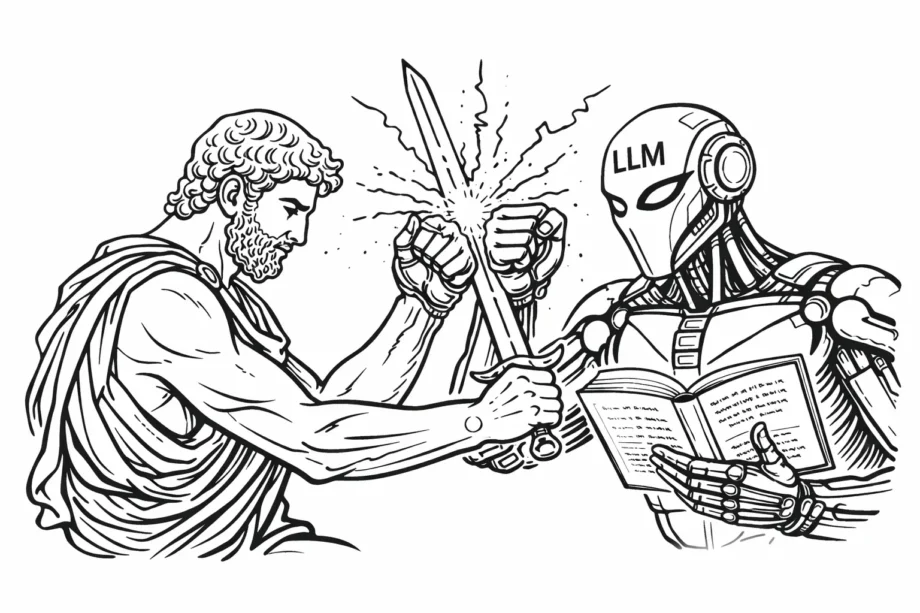


Everyone is freaking out about the coming rise of the machines (if it hasn’t already come).
Panic and coping and wishful thinking are widespread.. But there doesn’t need to be in Tech.
The truth is: Sure, AI is taking jobs.
If your job was mostly stitching together boilerplate, following tutorials, or repeating patterns you never really questioned — then yes, the competition just got brutal. Someone using AI-assisted workflows will leave their purist counterparts in the dust. They’ll be the most morally dignified programmers in the unemployment line yes, but it’s just reality.
The slow/no-adopter stance — “I don’t use AI, I do everything by hand” — sounds noble, but it’s not a strategy. In competitive environments, it’s self-sabotaging.
But here’s the part that gets lost in the fear: AI doesn’t remove the need for understanding. It amplifies it.
Principles are still greater than prompts
But prompts with principles followed by understanding and then manual oversight of quality is the winning combination.
If you know how systems fit together, how data flows, where bottlenecks form, how trade-offs work — Code-Assistance becomes a force multiplier. You can build things faster, try riskier ideas, and explore directions that were previously too time-consuming to justify.
If you don’t understand those foundations, prompts will get you surprisingly far… right up until they don’t.
And when AI reaches its limitations on you and starts pumping your codebase with spaghetti (which it absolutely does) — there’s often no prompt clever enough to bridge the gap. That’s where real understanding still matters.
The uncomfortable question about future developers
I do wonder what happens to the next generation of developers who grow up only prompting.
If you never struggle through the fundamentals, never hit the walls, never debug the ugly edge cases — do you actually build the mental models needed to go further?
We’ve already seen this pattern elsewhere. When you stop using something, you lose it. Muscles. Attention spans. Spatial awareness. (Like in Wall-E, chubby humans floating around in chairs on wheels because they no longer use their legs.)
If AI removes all friction, a lot of people will happily let their skills and abilities atrophy.
Ironically, that’s exactly why the small group who still understand the underlying mechanics may become more valuable, not less.
Fear comes from distance
Most AI fear I hear comes from people who keep it abstract.
“The AI.” “The models.” “The future.”
The fastest way to calm that fear is simple: get closer.
Run a local LLM.
Play with it.
Break it.
See where it’s impressive — and where it’s useless.
Right now, even with consumer hardware, you can experiment for free in ways that were unthinkable a few years ago. Once you do that, the monster under the bed turns into… a tool. Depending on your level of Autism – perhaps even a friend… And a powerful one.
Understanding replaces anxiety.
A quieter way to look at it
If you zoom out, there’s also something oddly positive here.
Individually, one person can now build more, test more ideas, and explore more creative directions than ever before. That doesn’t remove stress — but it does create opportunity.
And if nothing else, when you’re going to talk badly about the machines, don’t involve me — I’m choosing to stay on Skynets good side.
“Maybe the path through this moment isn’t denial or panic, but curiosity. And Play.“
Enjoyed this? Get new posts in your inbox.
Occasional dev notes and stories. No spam, unsubscribe anytime.

Interesting points Conn or however the bulk of the job losses are not going to be programmers, there just arent that many of you but retail workers, call centres, and the usually human interface between the corporation and the public and that boat has already sailed. And thats before we even get to the arts!
I am besieged by bots trying to sell me stuff but with insufficient insight to engage in a sales conversation. I will try and find the great stuff Colin Beardon has published on it